Fairy on the Moon: A Graphics & Crafts SVG for Designers
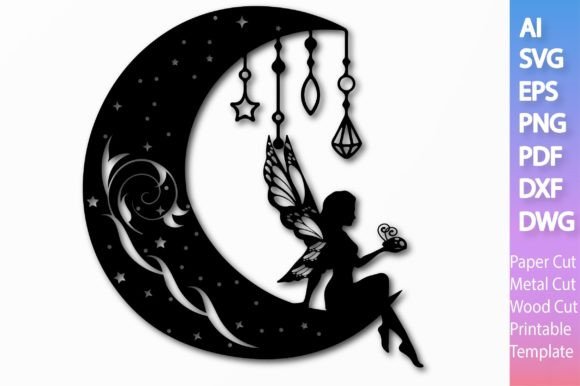
When I first opened the Fairy on the Moon Paper Laser SVG File 1, I was struck by the quiet narrative it carried. This is not a loud, crowded illustration. It is restrained, evocative, and built around a single poetic image—a fairy seated on a crescent moon. The silhouette-style treatment gives it a clean, timeless quality that immediately felt useful for real client work. As someone who regularly sources graphic design assets for branding, packaging, and social media campaigns, I look for visuals that do not fight for attention but instead invite the viewer in. This design does exactly that.
The mood leans into soft whimsy with a touch of celestial elegance. It feels like something you might see on a boutique product label, a handmade greeting card, or a piece of minimalist wall art. The fairy figure is delicate without being fussy, and the moon curve provides a strong foundational shape that anchors the composition. I found myself thinking about which of my current projects could benefit from this kind of restrained visual storytelling. That is always the first test: does this creative design spark a real application? For me, it did.
First Impressions and Real Client Project Fit
I recently began developing a brand identity for a small business called Luna & Thread, a handmade candle and apothecary line with a celestial theme. The founder wanted packaging and social media graphics that felt dreamy but not childish, refined but not cold. The Fairy on the Moon Paper Laser SVG File 1 came to mind almost immediately. The silhouette aesthetic aligns well with a modern, minimalist brand direction. It has enough detail to feel custom but enough simplicity to function across multiple formats—labels, hang tags, product mockups, and Instagram posts.
For a small business branding project like this, the design asset needs to be versatile. It must work in color and in black and white. It must scale from a tiny stamp on a candle lid to a hero graphic on a website banner. The fairy on the moon concept has a natural visual hierarchy: the moon is the strong base shape, and the fairy becomes the focal detail. This makes it easier to place into layouts without losing clarity. That kind of built-in structure is something I actively look for when reviewing design assets for client use.
How This SVG Performs Across Different Design Formats
I tested the Fairy on the Moon Paper Laser SVG File 1 in several real-world scenarios to see how it held up. The results were reassuring for anyone working in brand identity, printable design, or commercial design.
Brand Identity and Logo Concepts
As a logo mark, the fairy and moon combination works best for brands that want a decorative emblem rather than a strict typographic logo. I tried pairing it with a clean sans serif font for a modern feel and with a delicate script font for a more handcrafted look. Both worked well because the silhouette leaves room for type to breathe. For a logo, you would likely need to simplify the fairy detail slightly at very small sizes, but at standard logo display sizes—such as website headers or product labels—the design holds its shape clearly.
Packaging Design and Product Labels
This is where the design truly shines. I placed it on a mockup for a candle tin label and a soap box wrap. The moon silhouette created a natural frame for product information, and the fairy added personality without overwhelming the text. For packaging, I recommend using the design in a metallic foil effect or a soft matte emboss. Because the SVG is vector-based, it scales perfectly for print production. This is a strong candidate for handmade business branding, Etsy product packaging, and print-on-demand items.
Social Media Graphics and Digital Campaigns
For Instagram posts, Pinterest pins, and Facebook ads, the design works well as a background element or a central hero visual. I created a simple quote graphic with a pale moon phase behind the fairy and a short brand tagline beside it. The visual trust here is high—the imagery feels intentional and branded, not generic. For content creators and bloggers working on editorial design or themed collections, this asset can anchor a whole visual series. It is particularly effective for solstice or moon phase campaigns, spiritual wellness brands, and artisan product launches.
Printable Wall Art and Home Decor
Given the product description mentions Metal Wall Decor and Home Decoration, I tested the design as a printable wall art piece. At A4 and 8x10 sizes, the fairy silhouette remains crisp. The moonlight curve provides a natural border. I could see this being offered as a digital download on Etsy or used as part of a larger gallery wall collection. For print-on-demand sellers, this is a low-risk, high-appeal design that fits the minimalist art trend.
Cricut and Physical Craft Projects
For Cricut users and crafters who work with paper laser or metal wall art, the SVG structure is essential. The Fairy on the Moon Paper Laser SVG File 1 is well-suited for cutting machines because the shapes are connected and there are no floating elements that would fall apart during cutting. I previewed it in a Cricut design space mockup for a layered paper shadow box, and the result was clean and assemble-friendly. If you are selling physical products like wall signs or metal wall art, this file will save you time on troubleshooting cut lines.
Where the Design Works Best in Layouts
- Large hero areas: The moon curve fills space gracefully. Use it as a full-width header background or a central product mockup focal point.
- Decorative accents: Place it on the back of a business card, inside a product tag, or as a subtle watermark on social media graphics.
- Themed collections: Build a whole series around celestial motifs. This design can anchor a seasonal campaign or a limited-edition product line.
- Product mockups: It reads beautifully on candle labels, tote bags, mugs, and T-shirts. The silhouette style transfers well to both light and dark fabric colors.
- Printable designs: For sublimation design or direct-to-garment printing, the vector format gives you clean edges and no pixelation.
Where You Should Use This Asset with Care
No design asset is universal, and the Fairy on the Moon Paper Laser SVG File 1 has specific limitations that designers need to consider before committing to a client project.
- Small sizes: At very small scales—such as a favicon, a small stamp, or a tiny icon—the fairy detail may become muddy or lose definition. If you need a tiny brand mark, consider simplifying the silhouette further or using only the moon shape.
- Crowded layouts: This design needs room to breathe. Placing it on a busy background or inside a cluttered composition will reduce its impact. It works best with negative space around it.
- Low-contrast designs: Because the fairy and moon are a single silhouette, low contrast between the design and the background can cause the fairy to disappear. Test it on both light and dark backgrounds before finalizing.
- Minimalist branding: For brands that require extremely clean visual hierarchy—such as corporate professional materials or tech startups—this design may feel too decorative. It is better suited for lifestyle, handmade, and boutique brands.
- Professional corporate materials: Annual reports, legal documents, or B2B marketing visuals likely call for a different visual language. Reserve this asset for brands that embrace whimsy and storytelling.
Readability, Brand Consistency, and Emotional Appeal
One of the strongest qualities of this design is its emotional resonance. The fairy on the moon evokes a sense of wonder, calm, and gentle magic. For brands in the wellness, gift, or artisan space, this feeling is a direct asset. It builds audience engagement by appealing to nostalgia and aspiration simultaneously. When I showed a mockup to the founder of Luna & Thread, her reaction was immediate: “That feels exactly like the brand I want to build.” That kind of emotional alignment is not easy to achieve with a stock graphic design asset.
In terms of brand consistency, the silhouette style gives you a repeatable visual language. You can pair the fairy with other celestial elements—stars, clouds, moons—and maintain a cohesive look. This is especially useful for social media graphics, blog visuals, and product collections that need to feel like a family. For marketers and content creators, having a consistent illustration style across posts increases recognition and visual trust.
From a professional standpoint, the design does not overwhelm typography. I tested it alongside serif, sans serif, script, handwritten, and display font styles. It paired most naturally with a soft serif or a modern sans serif. Script fonts worked well when the letterforms were not too ornate. Display fonts with heavy weights clashed slightly, so I would recommend testing font choices before finalizing a layout.
Practical Designer Notes Before Using This Asset
Before you use the Fairy on the Moon Paper Laser SVG File 1 for a client project or a commercial product, there are a few checks I always run. These steps will save you from unexpected surprises during production.
- Test it in black and white first. Print a grayscale version on your home printer. If the design reads clearly without color, it will work across branded materials that use single-color printing.
- Check contrast on light and dark backgrounds. Place the SVG on a white background, a black background, and a mid-tone background. Adjust your fill color or use a stroke outline if the fairy detail disappears.
- Preview it at small and large sizes. Scale the design down to 1 inch and up to 12 inches. At small sizes, check whether the fairy’s wings and limbs remain distinguishable. At large sizes, check for any jagged edges in the vector path.
- Place it on real mockups. Use a product mockup for a mug, a T-shirt, a candle label, and a wall sign. This will show you how the design interacts with folds, curves, and fabric textures.
- Test print quality. If you are producing physical products, run a sample print. Check that the SVG file exports cleanly to PDF or PNG at 300 DPI. Confirm that the PNG transparency (if included) does not have halos or rough edges.
- Review file formats. Ensure you have the SVG vector file for scaling and the PNG file with transparency for quick placements. The SVG should be fully editable in your vector software. Check that the paths are closed and the layers are organized.
- Confirm commercial licensing. Before using this asset in a paid client project, a print-on-demand product, or a commercial design bundle, verify that the license covers your use case. Some creative marketplace files restrict commercial use or require attribution. Always read the license agreement carefully.
Why This Design Asset Belongs in Your Creative Library
After spending time with the Fairy on the Moon Paper Laser SVG File 1, I am confident that it is a worthwhile addition to any designer’s collection of graphic design assets. It is not a one-size-fits-all solution, but for the right project—a handmade business, a boutique product line, a celestial-themed campaign, a printable wall art collection, or a Cricut project—it delivers exactly the kind of polished, evocative visual that clients love.
The design bridges the gap between decorative art and functional design. It can serve as a logo mark, a packaging accent, a social media graphic, a sublimation design, or a piece of metal wall art. Its silhouette format gives it versatility across mediums, and its emotional tone gives it staying power. For designers, brand owners, marketers, content creators, crafters, digital sellers, and print-on-demand entrepreneurs, this is a solid, usable asset that can elevate a project without demanding excessive customization.
If you are building a brand identity for a small business, designing a product launch for an Etsy shop, or creating marketing visuals for a seasonal campaign, the Fairy on the Moon Paper Laser SVG File 1 is worth a serious look. It performed well in my tests across labels, packaging, digital ads, and printable designs. And most importantly, it made the client smile—which, in the end, is the only metric that truly matters.